
Fetal Horse Serum (FHS) premium plus
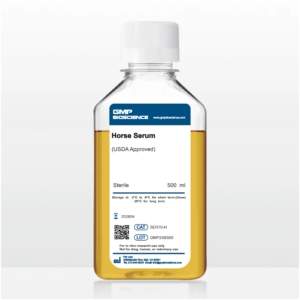
Fetal Horse Serum (FHS) premium plus
Fetal Horse Serum (FHS) premium plus
Achieving high reproducibility and consistency in in vitro cell culture experiments
remains a major challenge. One of the primary sources of variability arises from lot-to-
lot differences in biological components, particularly serum.
GMP BIOSCIENCE Fetal Horse Serum premium plus is specifically developed to
minimize such variability. Compared to standard sera available on the market, it
demonstrates significantly reduced batch-to-batch fluctuations. This improved
consistency is attributed to both rigorous analytical control and careful selection of fetal
source material, including precise control over fetal age.
Advantages of Fetal Horse Serum premium plus Over Fetal Horse Serum
premium
– Source quality: Differences in blood sourcing contribute to improved
performance.
– Enhanced cell growth: Fetal Horse Serum premium plus (UP-FHS) supports
significantly higher cell proliferation compared to standard premium formulations.
– Advanced analytical depth: More extensive and stringent testing ensures
superior consistency.
– Lot-to-lot reliability: A broader set of evaluated parameters improves
reproducibility across different production batches.
Quality Control and Analytical Testing
GMP BIOSCIENCE performs comprehensive testing on every lot of Fetal Horse Serum
premium plus (UP-FHS), in addition to standard quality control procedures outlined in
the Serum Analysis documentation.
Routine evaluation includes the following parameters (in approximate order of
importance):
IgG, total protein, iron, percent iron saturation, inorganic phosphorus, glucose, alkaline
phosphatase, potassium, albumin, blood urea nitrogen (BUN), sodium, calcium,
chloride, total bilirubin, creatinine, gamma globulin, lactate dehydrogenase (LDH), total
iron-binding capacity (TIBC), SGOT, and SGPT.
Key Features of GMP BIOSCIENCE Fetal Horse Serum premium plus (UP-FHS)
All products are sourced from the United States.
Sterilization is performed using gamma irradiation methods.
Heat inactivation is applied to improve compatibility with sensitive cell systems.
Each lot undergoes extensive analytical characterization, with results
documented in a Certificate of Analysis.