
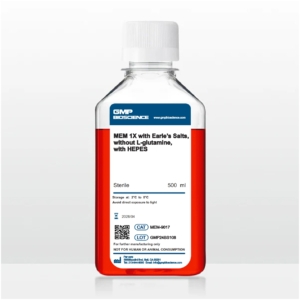
MEM Alpha–Modification with Nucleosides in Hanks’ Buffer Premium
(MEM-α-N-HBSS-Premium)
MEM-α-N-HBSS-Premium includes both L-Alanyl-L-Glutamine and nucleosides. This formulation is specifically designed to enhance cell viability and growth. GMP Bioscience offers various custom versions of MEM-α-N-Premium based on your specific research requirements.
Background
MEM-α-N-HBSS-Premium is a widely utilized medium for the cultivation of mammalian cells, especially in laboratory environments where serum supplementation needs to be minimized without compromising cell performance.
Composition
MEM-α-N-HBSS-Premium is composed of the following components:
– 5 mM Sodium Pyruvate
– High Glucose (4.5 g/L)
– Non-Essential Amino Acids
– 3.7 g/L Sodium Bicarbonate (GMP Bioscience manufactures multiple formulations tailored with different levels of Sodium Bicarbonate and HEPES for buffering capacity)
– Phenol Red
In addition, this medium is an enhanced version of GMP Bioscience’s
MEM-α-N-HBSS- Premium, supplemented with:
– Ribonucleosides
– Deoxyribonucleosides
MEM-α-N-HBSS-Premium does not contain proteins, lipids, or growth factors. As such, it requires supplementation, typically with 10% fetal bovine serum (FBS).
Advantages
Compared to MEM-α-N (HBSS), the Premium formulation offers:
– Enhanced pH buffering capacity
– Incorporation of 4 mM L-Alanyl-L-Glutamine (0.869 g/L) as a more stable alternative to L-Glutamine
– Extended shelf life
– Reduced formation of toxic ammonia
– Superior support for cell viability and proliferation
– Temperature stability across a broader range
– Improved performance for culturing primary cells
Mechanism:
While L-glutamine is an essential amino acid, it tends to break down over time, leading to the formation of harmful byproducts such as ammonia and pyrrolidine carboxylic acid. One strategy to reduce its degradation in culture media is by slowly supplementing it throughout the culture period. However, consistently monitoring and maintaining optimal levels can be labor-intensive and impractical.
A more efficient solution is to use L-alanyl-L-glutamine, which offers significantly greater stability in aqueous environments. Unlike free L- Glutamine, it resists degradation and releases aminopeptidases at a controlled rate. This results in a sustained supply of L-glutamine and L- alanine, which are then utilized by cells for protein synthesis and energy metabolism via the TCA cycle.