
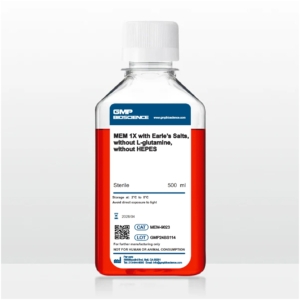
Minimum Essential Medium Alpha-Modification in Hank’s Buffer (MEM-α-HBBS-Premium)
MEM-α-HBBS-Premium is enriched with L-Alanyl-L-Glutamine, offering enhanced stability and a longer shelf life. MEM-α-HBBS-Premium substantially boosts cell viability and proliferation. GMP Bioscience produces various formulations of MEM-α-HBBS-Premium tailored to specific research needs.
Overview
MEM-α-HBBS-Premium is a widely utilized medium for culturing mammalian cells.
Key Benefits
MEM-α demonstrates superior performance over standard MEM across many cell lines (refer to the standard MEM-α description for details).
Notable advantages of MEM-α-HBBS-Premium compared to conventional MEM-α include:
– Enhanced pH buffering capacity
– Contains 4 mM L-Alanyl-L-Glutamine (0.869 g/L) in place of L-Glutamine,
which:
– Extends product shelf life
– Reduces the accumulation of harmful ammonia
– Greatly improves cell survival and proliferation
– Maintains stability across varied temperature ranges
– Enhances primary cell culture outcomes
Composition
MEM-α-HBBS-Premium includes:
– 5 mM sodium pyruvate
– High glucose (4.5 g/L)
– Non-essential amino acids
– 3.7 g/L sodium bicarbonate
(GMP Bioscience offers multiple MEM-α-HBBS-Premium variants with customized sodium bicarbonate and HEPES concentrations for specific pH control needs)
– Phenol Red
MEM-α-HBBS-Premium is protein-, lipid-, and growth factor-free. Therefore, it should be supplemented—typically with 10% fetal bovine serum (FBS)—for optimal performance.
Mechanism:
While L-glutamine is an essential amino acid, it tends to break down over time, leading to the formation of harmful byproducts such as ammonia and pyrrolidine carboxylic acid. One strategy to reduce its degradation in culture media is by slowly supplementing it throughout the culture period. However, consistently monitoring and maintaining optimal levels can be labor- intensive and impractical.
A more efficient solution is to use L-alanyl-L-glutamine, which offers significantly greater stability in aqueous environments. Unlike free L-glutamine, it resists degradation and releases aminopeptidases at a controlled rate. This results in a sustained supply of L-glutamine and L- alanine, which are then utilized by cells for protein synthesis and energy metabolism via the TCA cycle.