
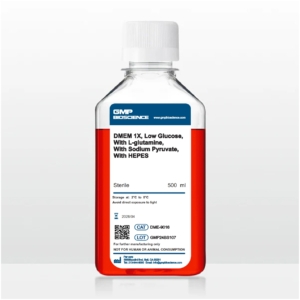
Iscove’s Modified Dulbecco’s Medium (IMDM Essential)
GMP Bioscience™ Iscove’s Modified Dulbecco’s Medium (IMDM) is formulated to support the growth of both rapidly dividing and slow-growing cell types. While it is primarily optimized for high-density, fast-proliferating cell lines, its composition is also conducive to the maintenance of adherent cells. A unique feature of this medium is its absence of iron, where potassium nitrate replaces ferric nitrate, contributing to its compatibility with adherent cultures.
Scientific Background
IMDM, developed as an enhanced version of Dulbecco’s Modified Eagle’s Medium (DMEM), is particularly well-suited for demanding cell lines such as Jurkat, HEK, COS-7, and macrophages. GMP Bioscience™ IMDM includes a broader spectrum of nutrients compared to standard DMEM, including additional amino acids, vitamins, and the trace element selenium.
Its iron-free formulation, achieved by substituting potassium nitrate for ferric nitrate, further enhances its performance in adherent cell culture systems.
Key Formulation Features
GMP Bioscience™ IMDM contains:
– Enhanced buffering capacity through elevated levels of sodium bicarbonate (3.02
g/L) and HEPES (5.9 g/L)
– High glucose concentration: 4.5 g/L
– Non-essential amino acids (NEAA)
– Sodium pyruvate: 110 mg/L (1.0 mM)
– Phenol red: 15 mg/L
– L-glutamine: 0.584 g/L
This formulation supports robust cell performance in both serum-supplemented and serum- reduced environments and is ideal for a variety of research and bioproduction applications requiring reliable, nutrient-rich culture conditions.
Mechanism:
While L-glutamine is an essential amino acid, it tends to break down over time, leading to the formation of harmful byproducts such as ammonia and pyrrolidine carboxylic acid. One strategy to reduce its degradation in culture media is by slowly supplementing it throughout the culture period. However, consistently monitoring and maintaining optimal levels can be labor-intensive and impractical.
A more efficient solution is to use L-alanyl-L-glutamine, which offers significantly greater stability in aqueous environments. Unlike free L-glutamine, it resists degradation and releases aminopeptidases at a controlled rate. This results in a sustained supply of L-glutamine and L- alanine, which are then utilized by cells for protein synthesis and energy metabolism via the TCA cycle.